
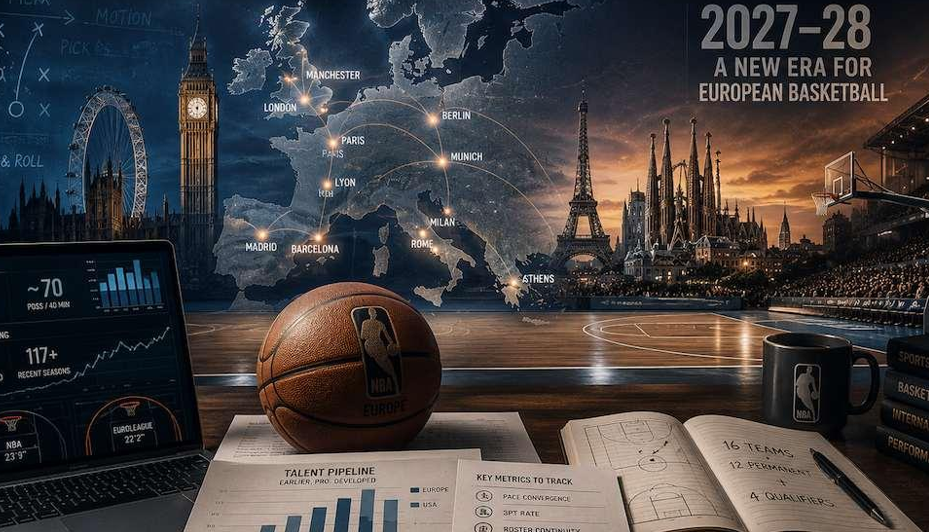
Adam Silver confirmed ahead of the 2026 Finals that NBA Europe remains on schedule for a 2027-28 launch, with final franchise bids due at the end of June and teams expected to be awarded in the autumn. The working model is 16 teams — 12 permanent franchises plus four annual qualifiers, with target cities including London, Manchester, Paris, Lyon, Madrid, Barcelona, Rome, Milan, Munich, Berlin, Athens and Istanbul. For anyone who works with basketball data, this is the most interesting problem the sport has handed us in years. Two versions of the same game, measured on different scales, about to be pushed into one commercial ecosystem.
Two Games That Look Alike And Count Differently
Start with the simplest trap. European games run 40 minutes, NBA games run 48, which means every raw per-game number crossing the Atlantic is wrong before you read it. Pace makes the gap wider still. A EuroLeague season typically produces around 70 possessions per game, while the NBA has run in the region of 101 per 48 minutes — roughly a 20 percent difference in tempo even after adjusting for game length. That single fact explains most of the “European basketball is slow” discourse. It is not that possessions are wasted, it is that they last about three seconds longer each. Efficiency has been climbing on both sides regardless. EuroLeague offensive rating has risen from roughly 108 points per 100 possessions a decade ago to the high 110s in recent seasons, which is the same curve the NBA rode through the 2010s, just delayed.
| Structural difference | NBA | EuroLeague |
| Game length | 48 minutes | 40 minutes |
| Typical pace | ~100 possessions | ~70 possessions |
| Three-point distance | 23’9″ (7.24m) | 22’2″ (6.75m) |
| Regular season | 82 games | ~34 plus domestic league |
| Roster churn | Heavy, trade-driven | Lower, contract-driven |
| Officiating emphasis | Freedom of movement | Physicality permitted |
The shorter arc matters more than most American analysts assume. A 6.75m line changes the geometry of the corner, shortens closeout distances and makes the mid-range less punitive, which is exactly why “Moreyball” arrived in Europe softened rather than wholesale.
Fragmentation Is The Real Story
Here is the structural point that gets lost behind the shiny franchise names. European basketball is not one market. It is roughly thirty of them, each with its own domestic league, schedule, tax regime and broadcast deal, stitched loosely together by continental competitions. That fragmentation is not unique to sport. Every consumer-facing industry that crosses European borders hits the same wall. Basketball has the identical problem in a different costume. A Spanish club and a Lithuanian club do not share a labor market, a media rights environment or a fan-monetization model, and no amount of shared branding erases that overnight. Which is why the four qualifying slots are the most analytically interesting part of the design. Promotion pathways are a European sporting convention that no closed North American league has ever had to model.
The Talent Math Already Pointed This Way
The league is not arriving into a vacuum. Roughly one in six current NBA players comes from Europe, and Nikola Jokić and Giannis Antetokounmpo alone accounted for five MVP awards across a seven-year stretch, with Luka Dončić out of Slovenia and Victor Wembanyama out of France now carrying the same conversation. The development pipeline explains a lot of it. A European prospect signs professionally at 16, trains against adults daily and plays meaningful minutes in a competitive league years before an American peer finishes a college season. That produces a specific statistical signature. Lower usage, higher assist-to-turnover ratios and better off-ball movement numbers at the same age, because the system rewards decisions rather than volume.
Coverage Is Still Stubbornly Local
The commercial side reveals the same pattern as the sporting one. European audiences are served in their own languages by their own local operators, from national broadcast deals down to niche market coverage like the Slovenian-language reviews at casinoslovenija10, rather than by a single continental platform. Any pan-European league inherits that reality. Selling one product across twelve countries, six languages and a dozen regulatory regimes is a harder problem than sourcing the talent, and it is the problem the NBA has actually signed up to solve.
Five Things Analysts Should Track With Tip-Off
- Pace convergence. If NBA Europe teams push past 75 possessions per 40 minutes in year one, the league is being deliberately Americanized.
- Three-point rate against the shorter arc. Expect attempt volume to rise faster than accuracy, exactly as it did in the NBA between 2013 and 2018.
- Roster continuity. European clubs retain players longer. Watch whether franchise economics erode that, because continuity is one of the few edges Europe holds.
- Free throw rate. The single cleanest proxy for whether FIBA or NBA officiating norms win out.
- Home-court effect size. European arenas have historically produced larger home advantages than NBA venues. If that survives, it is the most valuable modelling input in the league.
The Experiment Is Worth Measuring Properly
Whatever the new league becomes, it will generate the first large sample of the same players, coaches and systems operating under blended rules. That is a rare thing in sports analytics. We almost never get a controlled comparison of two basketball cultures, and from October 2027 we will have one running twice a week. Just remember to normalize for possessions before you post the takes.